Before the Stopwatch: How Runners Kept Time
Before the stopwatch, runners used daylight, landmarks, and public clocks. See how portable watches changed running timekeeping and the shape of a result.
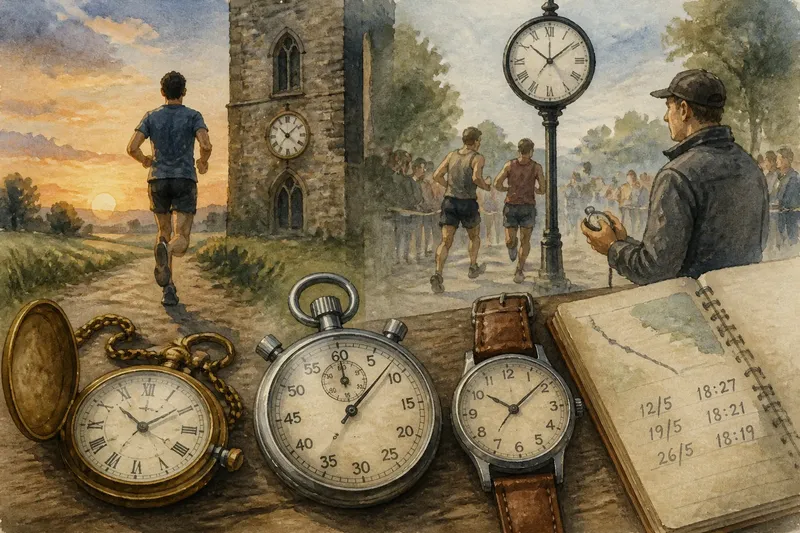
Before the stopwatch, a runner could use a church clock, a familiar landmark, or the fading light to judge how long an outing had taken. Running timekeeping grew more precise as portable watches became available, but the change was not simply from guesswork to accuracy. It altered what runners could record, repeat, and treat as a result.
Everyday Time Cues
Without a personal timepiece, a runner could leave at a familiar point in the day and return before a household task or nightfall. A known route offered another reference: the runner could recognize whether the outing felt shorter or longer than usual without assigning it a clock time.
These are broad descriptions of practical ways to mark duration, not a claim that all runners in a particular period or place followed the same custom. The available cues depended on local routines, access to clocks, and what the run was for. A messenger, a worker, and a person running for recreation did not necessarily need the same measure.
In such settings, the useful question might be whether a runner could reach a destination before a task began, or sustain an effort until the next landmark. Those answers described purpose and experience. They did not create a standardized record that could readily be compared with another runner’s.
Clocks At Events
A public clock or a timekeeper at a running event made elapsed time visible to more than the runner. An agreed start signal gave the group a common beginning, and an observer could note when a competitor reached the finish. The clock might stay near the course rather than travel with each participant.
That arrangement made a race result possible, but ordinary practice often left no written trace. Timing an event also relied on people coordinating the start, watching the finish, and recording the result. The more complicated the finish, the more important shared rules and attentive timekeepers became.
A recorded result belonged to its event and its method. A clock reading could not, by itself, describe the route, effort, or circumstances that produced it. The history here is less a clean march toward perfect measurement than a gradual expansion of what could be timed and shared.
Watches On The Run
Portable timepieces brought the clock closer to the runner. A pocket watch could be carried and consulted, while a wristwatch kept the dial nearer the runner’s gaze. A stopwatch offered a way to time a defined effort, provided someone started and stopped it at the intended moments.
These tools made it easier to divide a run into timed portions. A runner could describe an effort by its duration rather than only by a landmark or sensation, then repeat that structure in a later session. The watch supplied a new kind of detail; it did not explain what the effort meant.
Say a runner uses a familiar park path and wants to repeat a short effort between two gates. The starting inputs are the same gates, a stopwatch, and a plan to begin timing at the first gate and stop at the second. The runner follows those actions on a later outing and records the elapsed time. The result is a timed segment that can be compared with another attempt on that path, while it still says nothing by itself about how strenuous either effort felt.
Questions About Timing?
What did runners use before watches?
They could use daylight, recognizable places, daily tasks, or a clock available to the community. Such cues helped mark duration or a destination, but they did not necessarily produce a portable, standardized time.
What did a stopwatch add?
A stopwatch let a runner or companion time a particular effort and its start and finish. That made timed repetitions easier to describe, though the reading still depended on the person operating it.
Did portable watches replace older cues?
No single device erased the usefulness of landmarks, daylight, or bodily awareness. A watch could record elapsed time, while other cues answered different questions about destination, effort, and the shape of an outing.
What does a recorded run time represent?
It represents elapsed time as recorded by a particular timing method. It does not, on its own, explain the route, the runner’s effort, or the purpose of the run.
From Mark To Memory
Portable timing helped turn a run into a durable entry: a date, an elapsed time, or a sequence of timed efforts. That changed the relationship between running and memory. A runner could look back at a record rather than rely only on recollection, and organized groups could share results in a common form.
The shift also made time more prominent. Once a run could be reduced to a clear mark, it became easier to treat that mark as the whole story. Yet the older cues retained their place: landmarks can orient a runner, and a sense of effort can describe what a clock leaves out.
Running timekeeping is therefore not just a tale of better watches. It is a history of changing questions: from “Will I get there before dark?” to “How long was that effort?” A time record is most revealing when its limits are understood alongside what it can preserve.