Your First Race Morning, Without the Rush
Plan your first race morning around a simple personal ritual, so familiar cues steady your attention and leave room to respond to the event itself.
Your first race morning can feel less like a queue of chores when you give it a personal ritual. A small, repeatable cue—one song, a familiar stretch, or the same quiet moment before leaving—can mark the shift from ordinary morning to race day without adding another task to manage.
Imagine Maya, an invented first-time entrant in a local road race. She already knows where to check in and how she will get there. What she wants is a way to arrive feeling present, not as if she has spent the morning rehearsing emergencies. She chooses a short ritual built around things she already likes, then makes sure it can bend if the event is noisy or crowded.
A ritual with a purpose
A useful race-day ritual is not a superstition or a performance guarantee. It is a familiar sequence that gives your attention somewhere steady to land. The best version is personal, brief and easy to repeat in different settings.
Think of it as a few cues, not a strict script. You might play one familiar track while getting dressed, take a slow breath before joining the start area, or touch the race bib once after checking that it is secure. The point is recognition: your body and attention know this sequence, even when the surroundings are new.
Keep the ritual separate from event requirements. A required check-in, safety instruction or call to move toward the start takes priority over a preferred song or stretch. If an event volunteer redirects runners, follow that direction and pick up your personal routine afterward.
Build familiar cues
Maya chooses three cues she already uses on ordinary run days: the same playlist for getting dressed, a comfortable shoulder roll before she leaves, and a quiet phrase she says to herself while waiting. She does not add unfamiliar breathing drills or a new breakfast. That keeps the ritual recognizable rather than turning race morning into an experiment.
A cue should have a clear place in the morning. Music can accompany dressing, a stretch can happen after shoes are on, and a short pause can fit while waiting for the start. Linking each cue to an existing action makes it easier to remember without checking a list.
- Music: If a familiar song helps you settle and your phone or headphones are allowed and practical, use it during a private moment; if announcements or event rules make it unsuitable, skip it and use a quiet phrase instead.
- Movement: If a gentle movement already feels comfortable, use that familiar motion; if it causes discomfort or feels forced, leave it out and stand or sit comfortably.
- Breathing: If a natural, unforced breath helps you pause, take one before entering the start area; if focusing on breathing makes you uneasy, shift attention to a visible landmark.
- Words: If a short phrase feels encouraging without demanding a particular outcome, repeat it once; if it sounds artificial, choose a simple observation such as noticing the ground beneath your feet.
- Objects: If touching a secure bib or familiar item is unobtrusive, use it as a cue; if the item is not permitted or could distract you, rely on a sound or visual cue.
- Silence: If a quiet pause is available, use it to notice your surroundings; if the area is busy or staff are giving instructions, listen and resume the pause later.
Keep it flexible
Race venues rarely feel like a private living room. A speaker may interrupt a song, a friend may need your attention, or a volunteer may ask runners to move. A ritual that depends on exact timing or a particular corner can become one more source of pressure.
Give each cue a fallback. If you cannot listen to music, use a phrase. If there is no space to stretch, take a moment to relax your shoulders while standing clear of the crowd. If the start is called sooner than expected, drop the ritual and follow event directions. Nothing is lost by adapting a routine designed to help you, rather than control the morning.
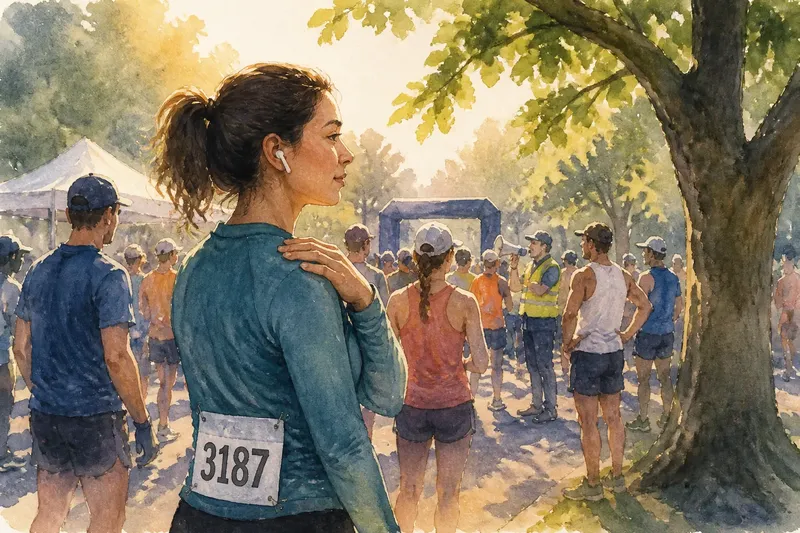
Say you, like Maya, planned to hear a familiar song while waiting, but the start area is too crowded for headphones and the announcer is giving instructions. She puts the phone away, checks that her bib is secure, and looks at a tree beside the course while taking a comfortable breath. The observable result is simple: she has replaced the song with a quiet visual cue and can keep listening for event directions. Her tradeoff is giving up the soundtrack in exchange for staying attentive.
Race morning rituals?
What makes a good pre-race ritual?
Choose a familiar action that feels calming or grounding, such as a song, a comfortable movement or a short phrase. Keep it simple enough to adapt when the venue or schedule changes.
Should I try a new routine before a race?
Race morning is a poor time to discover whether an unfamiliar routine suits you. Use cues you already know, and leave new practices for an ordinary day when there is no event pressure.
Can a ritual be superstition?
A ritual can become stressful if you believe the race depends on completing it exactly. Treat it instead as a flexible reminder to pause; if circumstances interrupt it, continue with the event.
What if I feel nervous at the start?
Notice one concrete thing around you, such as the ground, a sign or the sound of the crowd, and let your attention rest there briefly. If anxiety feels intense or affects your health, seek guidance from a qualified professional.
After the start
Once the race begins, let the ritual end. It has served its purpose if it helped you arrive at the starting line with a familiar point of focus. You do not need to repeat it at every mile or judge the run by whether the morning felt perfectly calm.
Afterward, remember which cue was easy to use and which one felt awkward. Maya may keep her phrase and shoulder roll for another event while leaving the playlist at home if the venue is too loud. For your own first race morning, a flexible ritual can make the transition into race day feel familiar—without taking your attention away from the people, instructions and course around you.